Luma Dream Machine
Luma Labs’ Dream Machine / Luma Agents workspace — first-party Ray video (Ray3.2 / Ray3.14) plus hosted third-party models on a credit canvas for cinematic faceless B-roll, image-to-video, and short social ads.
What it is
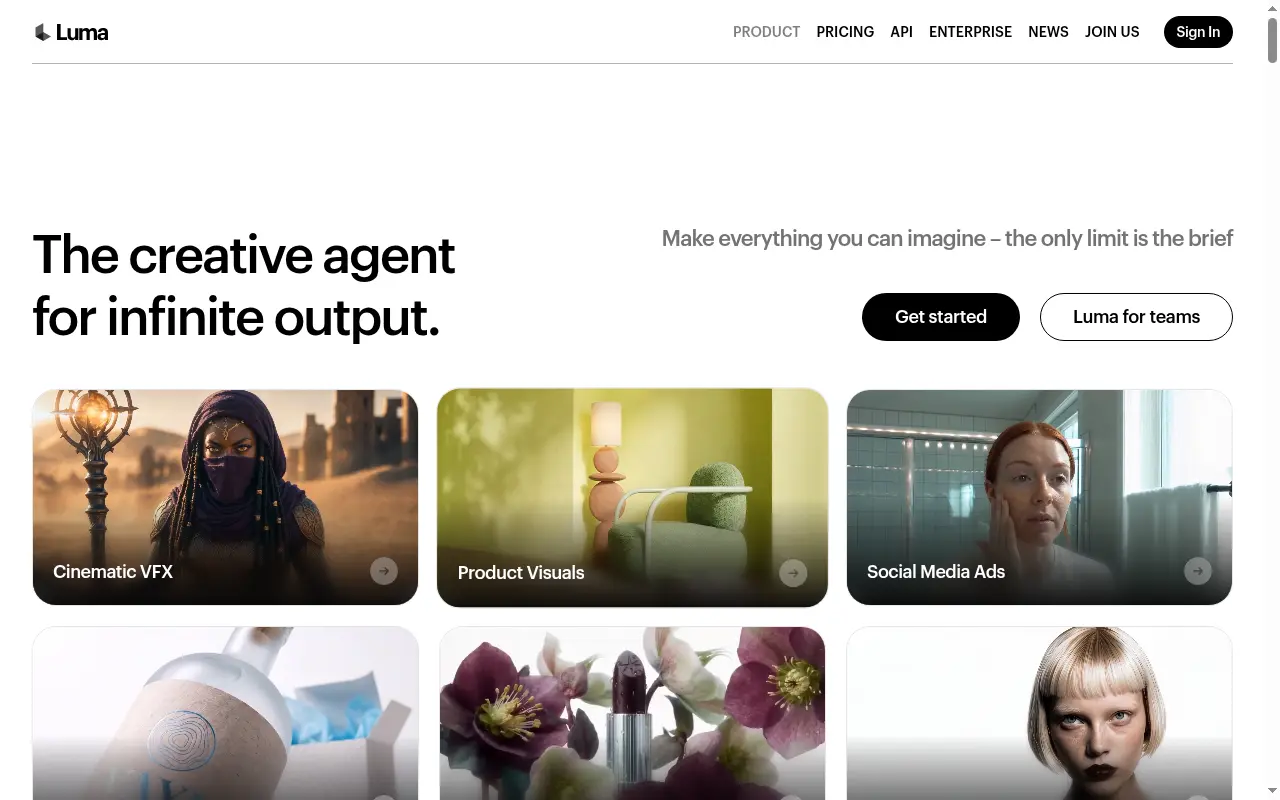
Luma Dream Machine is Luma Labs’ generative creative product (lumalabs.ai). The public product surface reviewed 2026-09-21 is the Dream Machine / Luma Agents workspace: an agent-driven infinite canvas that plans, generates, and iterates images, video, and audio with shared context — not a single one-shot prompt box alone.
The faceless B-roll job is generative coverage: text-to-video or image-to-video (and video-to-video / reframe on Ray), export a short clip, then finish voiceover, captions, and pacing in CapCut, VEED, Descript, Clipchamp, Kapwing, or Submagic. First-party video models named on official pages include Ray3.2 and Ray3.14 (plus Uni-1 on the model strip). Ray3.2 official docs: text2video / image2video at 5 or 10 seconds, resolutions 360p (Draft) / 540p / 720p (default) / 1080p, up to 16 keyframes, Modify Video (V2V) up to ~20s depending on source frame rate, Reframe for aspect ratios including 9:16, native HDR / EXR options for pro pipelines, and no natively generated audio on T2V/I2V (add VO/SFX/music separately; Modify/Reframe can preserve source audio). The Agents surface also hosts third-party models called out on the homepage/pricing tables (examples reviewed 2026-09-21: Kling 3.0 / Omni, Veo 3.1, Seedance 2.0 / 2.5, Minimax H3, ElevenLabs music/SFX/TTS, assorted image models).
It is not Kling, PixVerse, Dreamina, Runway, Vidu, or Higgsfield (already listed): those are rival first-party (or CapCut-family) labs — Luma is another native model home (Ray) that also rents other labs’ models inside one credit wallet. Prefer Kling when first-party Multi-Shot / Native Audio / VIDEO 3.0 credit math already wins; prefer Runway when Gen-4.x / Aleph suite tools matter more; prefer PixVerse / Dreamina / Vidu when those looks and prices fit; prefer Pollo or DeeVid (already listed) when you only want a multi-model desk without paying for Luma’s Agents canvas + Ray. It is not HeyGen / Synthesia (avatar presenters as the product). It is not InVideo / Fliki / Pictory (script-to-stock assemblers). It is not CapCut / VEED / Descript / Clipchamp / Kapwing (timeline editors). It is not ElevenLabs as a standalone voice factory (Luma can burn ElevenLabs-named audio credits inside its wallet — different seat). It is not Submagic / Opus Clip, Epidemic Sound / Artlist / Suno, Leonardo / Firefly / Midjourney / Canva, or Pexels / Pixabay.
Official framing: “Creative agents for creative professionals,” agency/case-study logos on the Dream Machine page, and social-ad / podcast-to-video / trailer use cases in the marketing grid — treat user-count and agency-name marketing as vendor claims, not an independent audit.
Who it’s for
Use it if your bottleneck is cinematic or camera-controlled B-roll stock cannot match — surreal explainers, product lifestyle motion, keyframed image-to-video, Modify Video restyles, or 9:16 reframes — and you want Ray first-party controls or a single Agents canvas that can also route Kling/Veo/Seedance/Minimax generations under one credit pool. Faceless fits: prompt or still → short silent Ray clip under an ElevenLabs/CapCut voiceover; campaign variations on the canvas; Draft-resolution experiments before burning 1080p credits.
Skip free/legacy personal-only output as a monetized publish plan — pay at least Plus (live pricing card lists Commercial use) before you treat exports as YouTube/TikTok inventory; re-read live Terms + any watermark path in-app. Skip if Kling, Runway, PixVerse, Dreamina, Vidu, Pollo, or DeeVid already owns your generative seat and consolidating would not cancel spend — Luma’s Plus entry ($30/mo list) is steeper than several already-listed labs’ starter paid tiers. Skip expecting Ray T2V/I2V to ship native dialogue/SFX (official Ray3.2 FAQ: no natively-generated audio on those paths). Skip treating unused monthly credits as a bank — official FAQ: credits reset and do not roll over. Skip if you only need free filmed stock (Pexels/Pixabay) or a presenter avatar as the whole product (HeyGen/Synthesia).
Standout details
- Official surfaces: lumalabs.ai/dream-machine · pricing lumalabs.ai/pricing · Ray3.2 lumalabs.ai/ray3-2 · Learning Hub / Agents FAQ · API path linked from Ray pages · Discord / Contact linked from site nav.
- Product names in market: Dream Machine (legacy/search brand), Luma Agents (current workspace framing), Luma AI (directory/traffic label). Same company: Luma Labs (lumalabs.ai).
- First-party video: Ray3.2 (multi-keyframe T2V/I2V, Modify Video, Reframe, HDR/EXR) · Ray3.14 (cheaper per-second rows on the pricing table, including extend-video). Official Ray3.2 lengths: 5s / 10s native T2V/I2V; Modify Video up to 20s @24fps (shorter at higher fps).
- Individual plan cards (pricing page, 2026-09-21): Plus $30/mo (10k credits) · Pro $90/mo (40k) · Ultra $300/mo (150k), with yearly discounts shown on the same page. Team / Enterprise = sales-led.
- Credit economics matter: a single 10s Ray3.2 clip at 1080p SDR is 1,200 credits on the public table — Plus’s 10,000 credits is roughly eight such clips before retries; Draft/720p burns far less. Budget hosted Veo/Kling/Seedance rows separately.
- Audio inside the wallet: pricing page lists ElevenLabs v3 TTS, SFX v2, Music v1 (and other audio utilities) as credit line items — useful for faceless VO/beds, but not a replacement for a dedicated claim-safe music library (Epidemic Sound / Artlist) or a primary ElevenLabs seat if voice is your bottleneck.
- Rights: live Plus card explicitly lists Commercial use. Older Learning Hub licensing summary (updated 2025-05-28) said Free/Lite = watermark + personal only; Plus/Unlimited/Enterprise = commercial + no watermark — reconcile against today’s Plus/Pro/Ultra cards and signed-in Terms before publishing.
- Traffic / search-intent justification: AICPB AI Video Generators Rankings by Website Visits — Issue 37 (Jun 2026), last updated Jul 8, 2026, lists Luma AI (~2.86M, #11) ahead of still-unlisted Hailuo AI|MiniMax (~2.76M, #13) and Pika Art (~2.04M, #16), and behind already-listed Dreamina, Kling, HeyGen, Pollo, PixVerse, Runwayml, DeeVid, and Vidu. After Vidu shipped (2026-09-20), Luma is the strongest remaining unlisted name on that public AICPB table among the Scout shortlist (Luma / Hailuo / Pika). Separate keyword directories also show large branded volumes for “luma ai” / “luma dream machine” — treat third-party volume estimates as directional, not audited.
Honest verdict
Try it. On the public AICPB table Luma is the clear next Unseen Stack ship in the generative B-roll lane after Vidu — a first-party Ray lab with real cinematic/control features and a multi-model Agents wallet — but Kling, PixVerse, Dreamina, Runway, Vidu, Pollo, and DeeVid already cover a lot of the same faceless job, and Plus at $30/mo list is not a casual add-on.
Start on the free trial path only to taste Ray Draft/720p prompts, Modify/Reframe behavior, and the Agents canvas. Move to Plus (or confirm the live entry commercial card) before monetized Shorts/TikToks so commercial-use language matches what you publish, and watch credit burn at 1080p closely. Prefer Kling when Multi-Shot / Native Audio / cheaper starter membership already fits; prefer Runway for suite depth; prefer PixVerse / Dreamina / Vidu when those looks win; prefer Pollo/DeeVid when one thin multi-model desk is enough; prefer Luma when Ray keyframe/Modify/HDR workflows or the Agents canvas beat those alternatives for your niche. Re-check lumalabs.ai/pricing stickers, generate-panel credit quotes, watermark/commercial path, and Terms the day you subscribe — plan names, hosted-model rows, and entitlements move, and unused credits do not roll over.